Waves are one way that energy can be transferred. In a wave the energy moves as a vibration. Examples of waves are light (electromagnetic waves), sound and the waves on water.
While waves can transfer energy, any material that the wave moves through will not get moved. For example, the waves in water make the water vibrate up and down but don't push the water, or any objects in the water, along. Sound waves vibrate the air but don't push it along.
Select
Waves can be described using these terms:
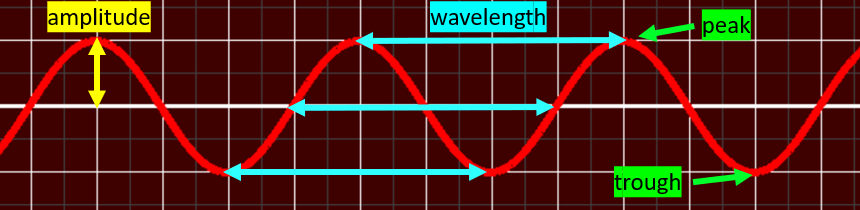
• Peak/crest - the top of the wave
• Trough - the bottom of the wave
• Frequency - the number of waves that pass a point in one second. Measured in Hertz (Hz).
• Wavelength - the distance covered by one complete wave (how long the wave is). This can be measured from peak to peak or trough to trough. Measured in metres (m).
• Amplitude - the maximum displacement (distance) that the wave can move from the middle. Measured in metres (m).
There are two different ways that waves can vibrate:
• Transverse - the vibration happens at right angles to the way the wave moves. This is the wave shown in the interactive by default.
• Longitudinal - the vibration happens in the same direction as the way the wave moves.
You can view longitudinal waves by selecting
The waves in the interactive go from left to right, by selecting
Sea waves and light are examples of transverse waves, and sound is an example of a longitudinal wave.
The speed of a wave depends on the wavelength and frequency, and can be found with the following equation:
Press
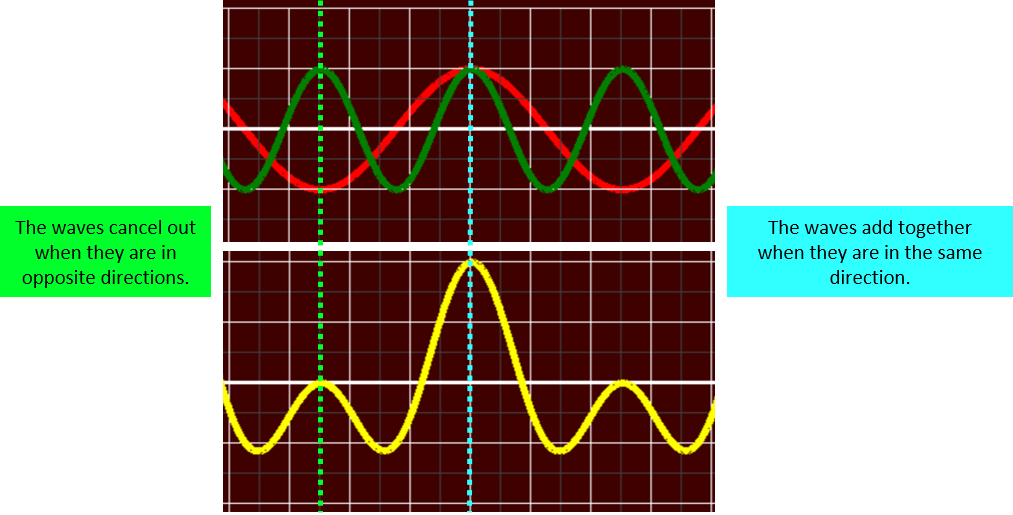
When two waves exist in the same place they can superimpose. The displacements of the two waves add together, forming a combined wave pattern. This might be two sound waves through the air or two waves crossing in the water.
Select
If the wave displacements at that position are both positive or both negative then they add together to make the displacement larger. If they are opposite to each other they cancel to make the displacement smaller.
A cool effect of superposition is noise cancelling. Noise cancelling headphones record the background noise and then add it to the sound that they play, but 180 degrees out of phase. This means that it cancels the background noise out.