
The Doppler effect is the apparent change in the frequency and wavelength of waves when their source moves towards or away from an observer.
An everyday example of this is a siren sounding higher pitched when it is coming towards you, and lower pitched when it is driving away from you.
Use the
This motion causes the waves in the direction of motion to be squashed and the wavelength reduced, and causes the waves behind to be stretched and the wavelength increased. Click on
This change in the sound wave causes it to sound different. Click on
The faster the motion compared to the listener, the greater the change in pitch.
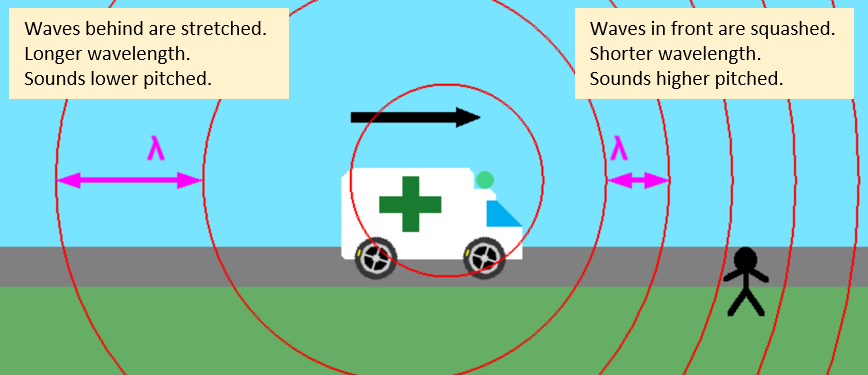
The pitch of a sound depends on the frequency of the wave, higher frequency means a higher pitch. So the change in pitch is actually caused by a change in frequency.
The frequency of a wave can be found with the following formula:
The wave speed of the sound wave depends on the medium it is travelling through, and won't be affected by the ambulance speed. So if the wavelength is decreased the frequency goes up, and if the wavelength is increased the frequency goes down.
This effect can happen to all waves, including sound, light and the waves on water.
The faster the waves are smaller the Doppler effect is, so only the fastest objects are able to cause a noticable Doppler effect on light. The doppler effect of light is called 'red shift' or 'blue shift', and it is covered here (click).