
Red shift and blue shift are an example of the Doppler effect happening to a light wave. The Dopper effect is covered here (click).
Objects need to be moving incredibly quickly for light to be noticeably affected by the Doppler effect, but it can be seen in galaxies.
Use the
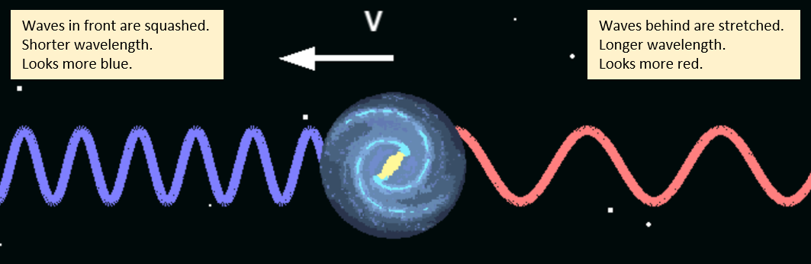
The light wave in front of the galaxy is squashed and the wavelength is decreased, the light wave behind the galaxy is stretched and the wavelength is increased. For a sound wave this change in wavelength changes the pitch of the sound, but for a light wave it changes the colour. This is because different wavelengths of visible light have different colours. If the wavelength is increased it will look more red, whereas if the wavelength is decreased it will look more blue.
The faster the motion towards or away, the more the light is blue or red shifted.
You can't tell if something is red shifted or blue shifted just from the colour; for example, a red galaxy might just be red. You need to be able to judge if the light or more red or blue than it would normally be.
You can determine this by looking at the absorption spectra of the light from the galaxy. Absorption spectra are covered in more detail here (click). They show the spectrum of the colours of light, with black lines representing where the colour is missing because it has been absorbed by the chemical elements in the galaxy.
These black 'absorption lines' are always produced in exactly the same place, so you can tell if something has been red shifted or blue shifted by checking to see if these lines have moved.
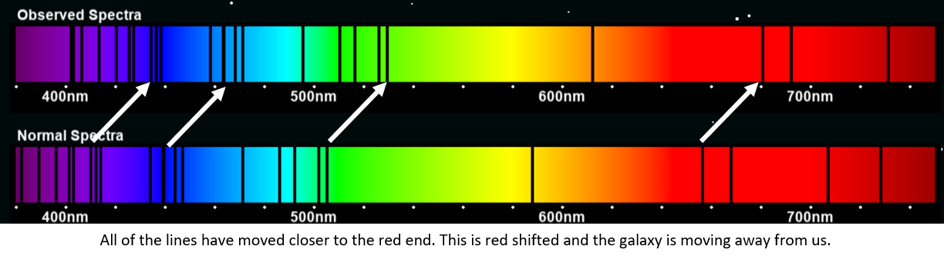
Check what happens to the absorption lines that are observed when you change the
The overwhelming majority (close to 100%) of the galaxies in the universe are red shifted and so are moving away from us.
Also, the further away a galaxy is, the more it is red-shifted and the faster it is moving away from us.
These observations are very strong evidence for a universe that is expanding, such as in the Big Bang theory.