
A nuclear fission reactor makes use of the energy released by nuclear fission to generate electricity.
If you are unfamiliar with nuclear fission it is covered here (click).
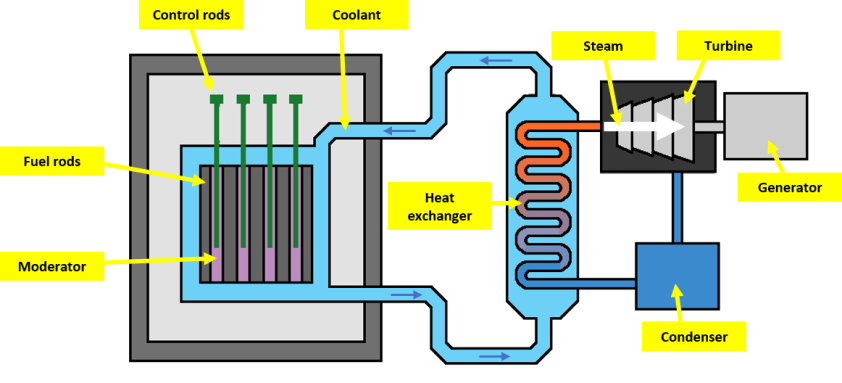
• Fuel rods - these contain the nuclei that undergo fission, for example uranium-235.
• Moderator - this material slows the neutrons down so that fission can happen. As explained in the nuclear fission interactive (click), nuclear fission of uranium-235 is more likely with slow moving neutrons.
• Control rods - these rods absorb neutrons to slow down the rate of fission, they can be raised or lowered (see section below).
• Coolant - this is pumped through the reactor to remove the heat and take it to the heat exchanger.
• Heat Exchanger - this uses the heat from the coolant to boil water into steam for a turbine.
• Turbine & generator - the steam from the heat exchanger spins the turbine and this spins the generator, making electricity.
• Condenser - condenses the steam back into water to go through the heat exchanger again.
If every neutron is able to cause a new fission the reaction will get larger and larger and the reactor will overheat dangerously. Control rods help to speed up or slow down the reaction by absorbing neutrons. They can be inserted or removed from the reactor, use the
• If the reactor is too cold - remove the control rods, so fewer neutrons get removed, so more fissions can happen.
• If the reactor is too hot - insert the control rods, so more neutrons get removed, so fewer fissions can happen.
If things get dangerously hot the operators can