
Nuclear fission is when a large nucleus splits up into two smaller nuclei (daughter nuclei) and releases energy.
All commerical nuclear power stations make use of nuclear fission, and a simple simulation of a nuclear fission reactor can be found here (click), though it is a good idea to understand what happens in fission first.
There are lots of isotopes that can be used to do a nuclear fission reaction, but a commonly used one (and the one in the interactive) is uranium-235.
To make uranium-235 undergo fission you first need to turn it into uranium-236. To do this you make it absorb one extra neutron. When uranium-235 absorbs a neutron, it briefly forms an unstable, excited uranium-236 nucleus. This can then split into two smaller nuclei, releasing energy and more neutrons.
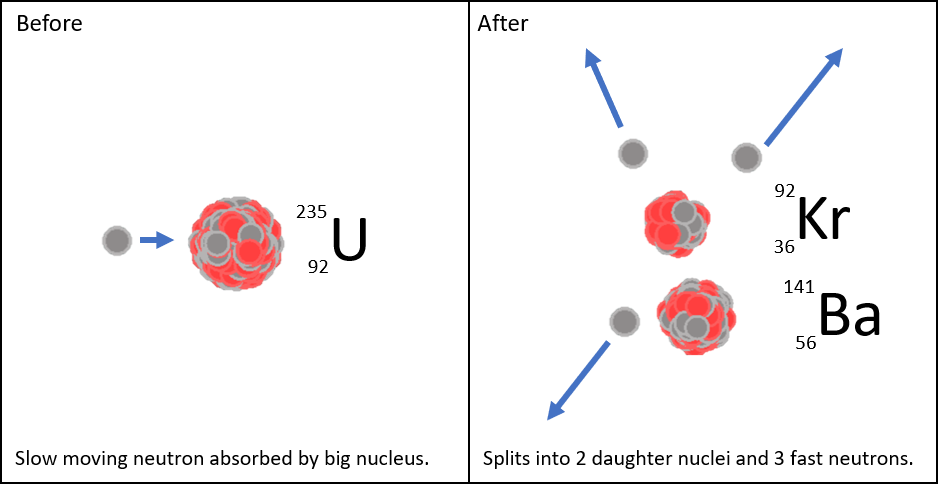
The uranium-235 absorbs slow neutrons more easily than faster ones. Click on
When a nucleus fissions it produces some extra neutrons. These neutrons can hit into new uranium-235 nuclei, get absorbed, and cause more fissions. This is called a chain reaction.
Click on
The interactive shows the chain reaction from the point of view of one neutron from each fission, but all three are able to cause a new fission reaction. This can very quickly get out of control and things called 'control rods' are needed to stop the reactor overheating. This is covered in more detail in the fission reactor interactive (click).